
Fail Forward
What Three Designers Taught Us About Growing Through Setbacks
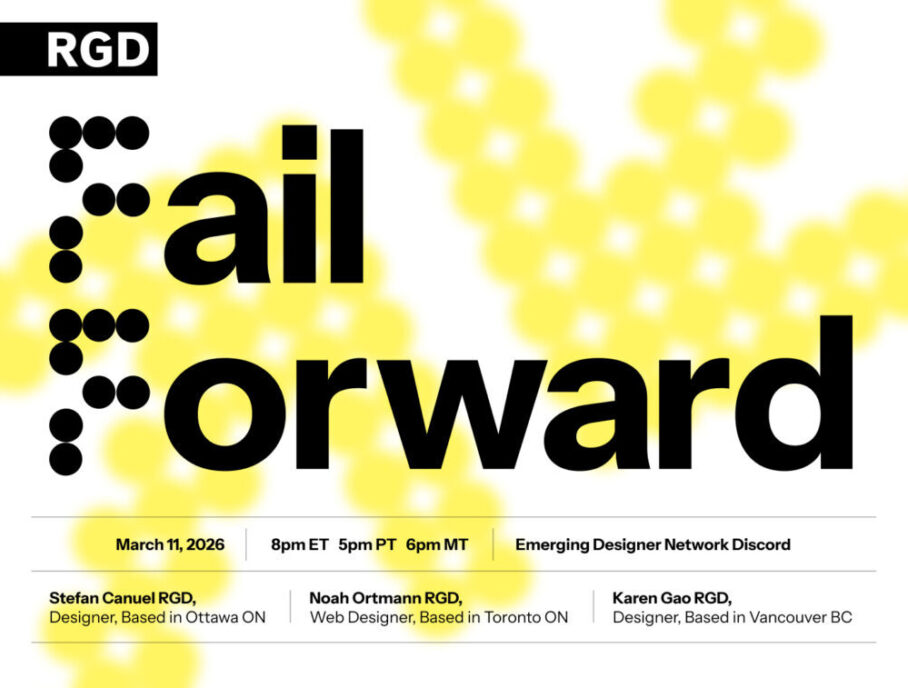
On the evening of March 11, the RGD's Student Committee hosted Fail Forward—an event designed not to celebrate polished portfolios or career highlights, but to do something rarer: talk honestly about struggle. Three experienced designers shared the missteps, dead ends and hard-won lessons that shaped their careers.
The speakers—Stefan Canuel RGD, Noah Ortmann RGD and Karen Gao RGD—brought different backgrounds and perspectives, but their messages converged on a shared truth: failure is not the end of a design career. It is a natural, possibly essential, part of one.
Karen Gao RGD — The Grit Behind the Gloss
Karen opened with what she called 'Fail Forward Bingo' — a framework built from the real moments in her career where things looked successful from the outside, but felt anything but.
One of her most candid revelations involved a $1.2 billion project that, by every professional measure, was a win. And yet, when it was over, she felt numb. "Success does not equal fulfillment," she reflected. Achievement and well-being are not the same metric. It was a reminder that the industry's definition of winning and a designer's sense of meaning don't always align—and that it's worth asking not just did we succeed? But at what cost and was it sustainable?"
"I used to respect how projects looked. Now I respect them for what they endured," shared Karen.
Karen also spoke with striking candour about job searching. She sent out 119 applications, landed 7 interviews and received 112 rejections. Rather than treating this as a source of shame, she reframed it: hiring decisions reflect timing, budget, team fit and risk tolerance—not just talent. "The nos do not define you," she said. "They lead you to the yes."
Other themes from her talk were equally practical: the limits of influence when a client overrides strategy (being right is not the goal, being trusted is), the disorientation of early-career trial by fire ("no one ever feels fully ready") and the lesson that design can only amplify clarity—it cannot create it. When a leadership team is misaligned, no amount of craft will make the work land.
She closed with a message about process: break every project into tasks, checklists and reviews. Extra minutes of review are always cheaper than mistakes and regret.
Noah Ortmann RGD — Don't Overthink It
Noah began by redefining failure itself. Rather than a dramatic collapse, he described it as 'a fuzzy grey area—the distance between where you are and where you want to be.' That subtle reframe set the tone for everything that followed.
His most memorable story involved a small, personal project: a handmade notebook listing local Toronto libraries, created as a birthday gift for his then-girlfriend. He eventually tweeted a mock-up. The Toronto Public Library retweeted it. People wanted to buy one. He started selling them online. And 11 years later, he still is.
"This little thing that I didn't overthink—I didn't think about what it would become. You can design for fun," explained Noah.
The library passport project didn't just become a product. It eventually helped Noah land his current role: the studio had heard about it, and it became part of what got him hired. But that only happened because he was ready when the moment arrived. Timing, he argued, is a real factor— and staying curious and creative outside of client work keeps you prepared for it.
Stefan Canuel RGD — Finding Your Own Path
Stefan Canuel brought a different kind of story to the evening, one less structured around specific projects and more rooted in the non-linear shape of a 20-year career. He finished high school with no idea what graphic design even was, only knowing he loved both art and mathematics. His early years in a design program were spent trying to please everyone, making work that didn't come from the heart.
He entered as an illustrator and discovered typography and that shift changed everything. He moved into packaging design in Montreal, did some illustration for television and eventually found himself drawn not just to how things looked, but to how they felt: "I discovered I like touching what I do. Not just the visual — all the senses."
"Designing is my passion. It can be overwhelming, always trying to do better—but it's a fun field to be in," said Stefan.
A stint at the National Gallery alongside freelance work eventually shaped his approach to feedback—one of the more universal truths he shared. Every time you present work, people will comment. The key is learning to distinguish personal responses from professional ones, and not letting either destabilize you.
He also offered a practical lesson born from a real mistake: an oversized banner where the text looked perfect on screen but was unreadable at street level. Now, he said, any time he designs something meant to be seen from a distance, he makes it look unbalanced on screen so it reads correctly in the real world. The mistake became a methodology.
From the Room: Q&A Highlights
The event closed with an open Q&A that pushed all three speakers to go deeper. On the question of comparison, Noah acknowledged it never fully goes away—but noted that you're often measuring your low point against someone else's highlight reel. Stefan added that the work you don't see—the projects designers aren't proud of—far outnumbers the portfolio pieces. "We all do some work we aren't really proud of. But you'll end up doing great work as well."
When asked how their definition of failure has evolved, Karen offered perhaps the most grounding response: "Nothing is linear. It's practising the mindset of managing setbacks. Your timeline might look different, and that's okay. Your identity should not be based on work failure or work success."

Priya Shukle Associate RGD
Hi I'm Priya Shukle! I'm an Indian-Polish-Canadian graphic designer and illustrator with a passion for design that supports people and communities. My favourite parts of the design process are the early stages of research and ideation that set the foundation for new insights to be discovered. Working with The City of Calgary, the RGD, and Alberta University of the Arts has reinforced my passion for community-focused projects with an empathetic and strategic approach. I love spending time with clients and audiences to understand their unique perspectives and create something meaningful for them.
Related Articles



Priya Shukle Associate RGD, Jennifer Sutherland Associate RGD