Art as resistance with Edel Rodriguez
Episode 2 — DesignThinkers Podcast, Season 5

This episode of the DesignThinkers Podcast features Edel Rodriguez, a Cuban-American illustrator, painter and author whose confrontational magazine covers—for TIME and Der Spiegel—have made him one of the most recognizable political artists working today.
In conversation with RGD Past-President Nicola Hamilton RGD, Edel traces his path from a childhood in Cuba to becoming, by his own rough count, the illustrator of some three or four hundred pieces of art about a single American president. Along the way, he talks about the discipline of “marinating” on an idea instead of rushing it, the risk calculus every magazine editor takes on when they publish his work and why he thinks the most honest thing an artist can do is make something with no assignment and no purpose at all.
From a Havana schoolyard to a New York newsroom
Edel's story starts in Cuba, where he grew up in the school uniform that would later become a central image on the cover of his memoir. His family eventually left the country—“worm” was the word Cuba's government used for people who tried to leave and it's the word that gave his memoir its title. He studied painting, not graphic design, at the Pratt Institute in New York and it was the school's student newspaper, The Prattler, where he did his first illustrations, almost by accident.
His scrappy student portfolio was enough to get him freelance work at Spy, and, from there, an entry-level design job at TIME. He didn't stay entry-level for long. Bored during the long stretches of waiting that come with a weekly news magazine, he started mocking up cover ideas on his own and pitching them to the head art director— Arthur Hochstein, TIME's longtime art director—whenever news broke.
“I gotta do something to show I'm—so I would just come up with a cover, right?” Edel says of those early years. The art director kept encouraging him, and a handful of those unsolicited ideas made it to print. By 1997, at 25 or 26, Edel was tapped to become art director of TIME Canada and Latin America—over the doubts of an editor who thought he was too young for the job. He held the role for roughly 13 years, hiring illustrators and shaping the magazine's covers, before his own painting, illustration and children's book work made it impossible to keep doing both. He left TIME around 2008.
Self-publishing his way back onto the cover
Leaving TIME didn't end the relationship. It changed it. Rather than waiting to be commissioned, Edel began posting his own political illustrations online, treating the internet as a publishing platform in its own right. Roughly six months of steady posting built enough attention that TIME's art director reached out.
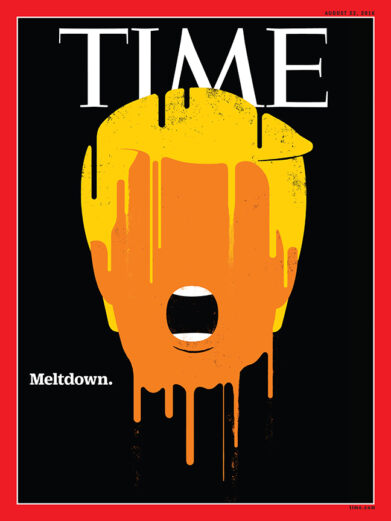
“I know that they're watching what you're doing to make a decision to hire you,” Edel says of that period, describing how the strategy worked: build a public body of opinionated work first, and let institutions come looking for the artist already generating conversation. The approach paid off. His first Trump cover for TIME—since nicknamed the “meltdown” cover—pushed further than he expected the magazine to go. They ran it. Der Spiegel followed soon after, commissioning work in a similarly unflinching style and its editor began writing a companion essay to accompany each cover rather than simply printing the image on its own.
Edel estimates he's made somewhere close to 12 official TIME covers on the subject of Donald Trump alone and, if you count everything—sketches, self-published pieces, magazine work—something closer to 400 illustrations in total. It's earned him an informal nickname he's quick to wave off: “America's Illustrator-in-Chief".
The stakes behind that first cover, he says, were never really about getting attention for its own sake. He wanted the image to do something specific: warn people.

“I really thought he was a danger and I needed a magazine to publish it as a danger.”
Edel Rodriguez, Owner at Edel Rodriguez Studio

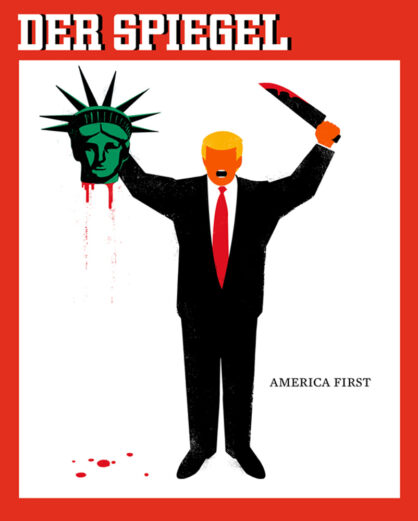

“These covers sit like in the middle of Oklahoma or Nebraska, on a coffee table, you know… it's a permanent object. It's not online where it just comes and goes.”
Edel Rodriguez, Owner at Edel Rodriguez Studio
What draws him to the format isn't the reach of any single publication online. It's the physical stubbornness of a printed cover sitting in a grocery store or on a coffee table, forcing a conversation that you can't just scroll away from.
Writing Worm
Edel's graphic memoir, Worm, took over a decade to become a finished book. He started conceptualizing it around 2012, drew the cover—a portrait of himself as a boy in his school uniform—before he'd written a word, and spent the following years interviewing his parents, his sister and the cousins who helped his family leave Cuba, piecing together the logistics of an escape he'd only ever known from the inside. A proposal came together around 2019, the manuscript was finished in 2020 and the book was published in 2023.


He describes the process behind that kind of long-gestating work with a phrase he repeats often: “I don't procrastinate, I marinate.”
Rather than forcing an idea to completion the moment it occurs to him, Edel lets projects sit—sometimes for years—gathering research and waiting for a “news peg,” a reason someone would actually want to publish it. As he puts it, the question he asks himself before pursuing any idea is simply why anyone would publish it—and if he doesn't have a good answer, he figures he probably doesn't have a good idea yet either.
It's a habit built directly out of his years inside TIME's newsroom, where timing wasn't a nicety—it was the whole game.
The cost of staying quiet
Much of the conversation returns to a theme that runs under almost everything Edel makes: his discomfort with self-censorship, and his conviction that quiet consensus is more dangerous to a society than loud disagreement.
“I tend to just be like, no, screw that. I'm still going to do what I want to do… I don't like when I see people hush or talk quietly about a topic. I really think that's one of the most dangerous things in any society because I lived it.”
He draws a direct line to Cuba, where he says he watched, over decades, how a culture of not speaking up eroded the country from the inside, independent of any outside pressure. It's part of why he says he's willing to be the one who tries to “scream the loudest” on a subject, hoping it gives other people, and other publications, permission to follow.


That conviction doesn't mean he's precious about how the work lands. Edel says he deliberately separates his own identity from the art once it leaves the studio.
“I don't attach myself to my work. I made it. I made it… if you criticize it, I actually get excited when people criticize it, because at least you're paying attention to it. So, you know, I'm a bit of a masochist when it comes to that.”
He treats strong reactions, even hostile ones, as proof the work did something. Readers of Worm, he notes, tend to split along political lines: more conservative readers say they loved the first part of the book but bristle at what they see as its harshness towards Trump in the later chapters; more left-leaning readers enjoy the anti-Trump material but take issue with how the book portrays the Cuban regime. He's come to see that split less as a verdict on the book and more as a kind of Rorschach test for the reader.
Painting more
Asked what question he'd want to ask himself about his creative career 20 years from now, Edel didn't hesitate for long. “I would probably ask myself, why didn't you paint more? Paint more.”
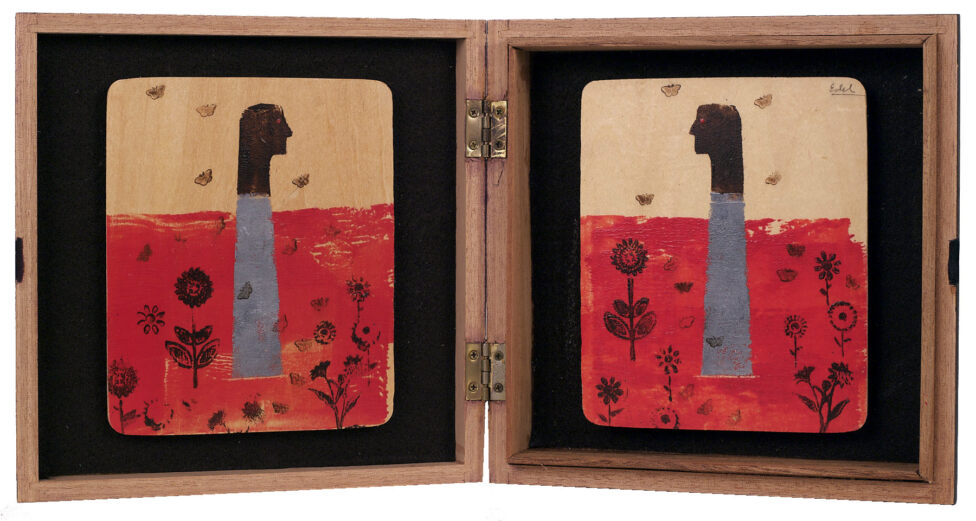
It's a return to his original training—painting, not illustration or design—and to a belief he says he tries to pass on to every student and young illustrator he talks to: that work made with no assignment and no purpose is often the most valuable work an artist can do.
“Making things for no purpose, I think, is the highest calling.”
He points to it as the source of new creative directions and as the most honest register an artist can work in—even as deadlines, email and the pull of the news cycle keep pulling him back toward the next commission.