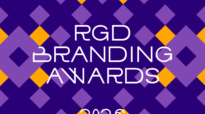
Significant Other is the Design Partner for the 2026 RGD Branding Awards

We have launched this year’s Awards with Design Partner Significant Other, who takes us through the creative process behind their brand concept.
Open to submissions from large and small creative agencies, design firms, in-house teams, solo designers and students worldwide, the RGD Branding Awards provide designers at every stage of their careers with a platform to showcase their work and gain recognition across the industry.
“Last year, our entire design team completed their RGD Certification, so getting more involved with an organization we had already committed to felt like a natural next step,” says Jacob Sharrard RGD, Co-founder at Significant Other. “We’ve benefitted from the RGD’s work over the years, both through its advocacy for the profession in Canada and as past Branding Award winners ourselves. There’s something satisfying about contributing to the identity of a program you already believe in. Designing for an audience of designers is also a more interesting challenge. You can’t rely on something safe when the people viewing it understand exactly how it’s made.”


We asked Significant Other about the sources of inspiration for the Break the Grid concept:
“Our research was intentionally broad at the start. We looked at everything from glitch art and pixel fonts to tangrams, block prints, historical cattle brands and trademarks. We were interested in how simple forms can generate a much larger visual language and how systems create meaning through repetition.
One of the turning points came from looking at textiles and quilting. It’s often categorized as craft rather than design, but that distinction has more to do with perception than the work itself. When you look closely, quilting operates within the language of graphic design—geometry, colour relationships, pattern and repetition at scale. That realization opened up a new way of thinking. It showed that a design system could carry significant visual energy while still feeling refined rather than chaotic.
From there, the process became an exercise in editing—identifying which references strengthened the idea and which needed to be removed.”


Unexpected lessons and discoveries
"The typography was its own unexpected journey. The core visual system is very geometric—lots of right angles, primitive shapes, strict grid logic so we wanted a typeface that could introduce something more organic and offbeat without breaking the system's internal rules.
DINdong felt right immediately. It has these quirky, slightly unpredictable proportions that push against the rigidity in exactly the right way. What we didn't anticipate was discovering just how vast the DIN family actually is. There are literally hundreds of variations and offshoots when you start mapping the full extended universe of the typeface. We started calling it the DINematic Universe internally. That should give you a sense of how deep we went. It ended up being one of the more joyfully absurd parts of the project."
Design process and system development
“The team began with the strategic and practical requirements before exploring visual directions. The identity needed to promote the Awards, complement the RGD brand, function across digital and physical applications and frame winners’ work without competing with it. These constraints shaped every decision."
From there, they explored multiple conceptual directions. The first round surfaced several strong ideas, and the second focused on refining the direction with the most flexibility and energy. A key part of this phase involved testing how the system performed across real-world applications.
Feedback from the RGD's Executive Director, Hilary Ashworth, and Creative Director, Karin Heinsch RGD, helped sharpen the work further, ensuring the final identity carried the level of distinction the Awards require.
During production, the team also developed a custom animated grid builder tool. The identity is based on a finite set of shapes governed by clear rules, making it possible to translate the system into a tool. What began as a practical solution to manage variations evolved into a powerful way to explore the system while maintaining consistency. It reflects a process where design and development worked in parallel, reinforcing each other throughout the project,” says Jacob.


Stay tuned for the 2026 RGD Branding Awards brand reveal details to be shared in April.
Tags
Related Articles


Sponsored