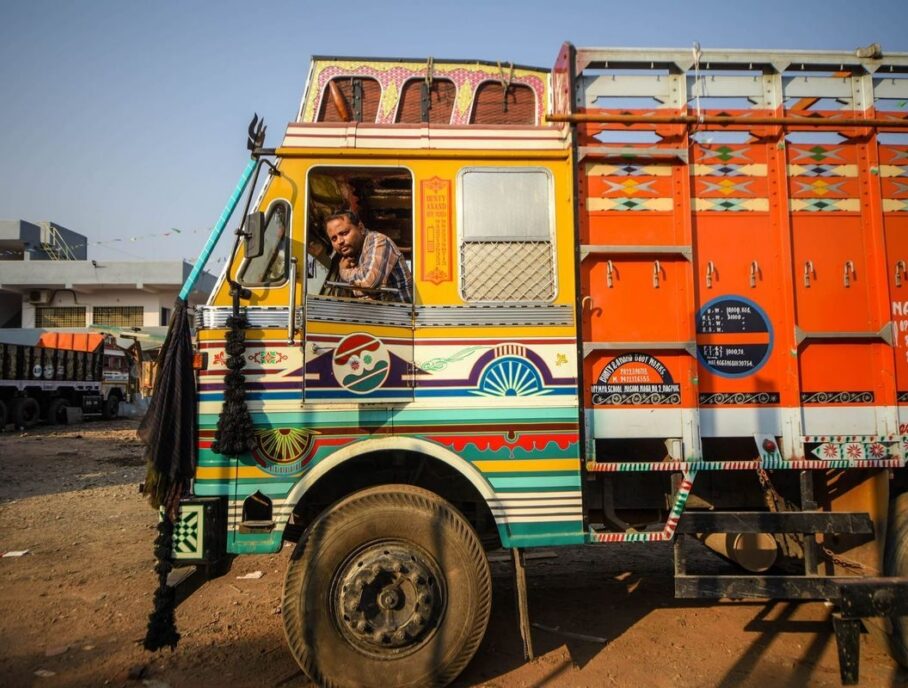
I was about eight years old on my first trip to India. I was unabashedly what you would call a nerd, and repelled any hope of “coolness” by reading fiction constantly and keeping a journal. So when we went on our first holiday there as a family, I kept a diary of the trip. I recorded anything and everything that seemed significant, different or weird.
I don’t remember much of the diary, with the exception of the fact that all of the trucks we saw had the strange expression “HORN OK PLEASE” on the back. I never knew what that was about, and my parents didn’t have an explanation either.
Fast forward to the present, when Instagram fills my feed with fascinating reels of the tradition of truck and bus painting that survives to this day.
So for this article I decided to find out more about this tradition, and hope to get an answer to that question that I never did unearth: why “HORN OK PLEASE”?!
Truck art is a decorative tradition found across India, Pakistan, Bangladesh and Nepal, where ordinary cargo trucks and buses get turned into rolling, hand-painted spectacles. No two are alike. Every one is commissioned by a driver, painted by a local artist and dense with symbolism that stumps most outsiders (myself included). It’s one of the most delightfully over-the-top design traditions in existence.
How a war surplus truck became a canvas
The story starts, oddly enough, with camouflage. Trucks first showed up on Indian roads in the 1920s under British rule, and once World War II ended, a lot of drab military-green cargo trucks got handed over for civilian freight work. Turns out nobody particularly wanted to drive, or ride in, a truck that looked like it belonged on a battlefield. So local artisans, the same people who’d spent generations decorating horse carriages and wooden boats, went to work on this newer mode of transportation.
By the early 1950s, General Motors had opened a truck plant in Karachi, and an artist named Haji Hussain, who’d been painting ceilings and carriages, became one of the first to move his brushes onto truck panels. He’s often called the father of modern truck painting. From there, the whole thing exploded regionally, and every area developed its own completely distinct flavour.
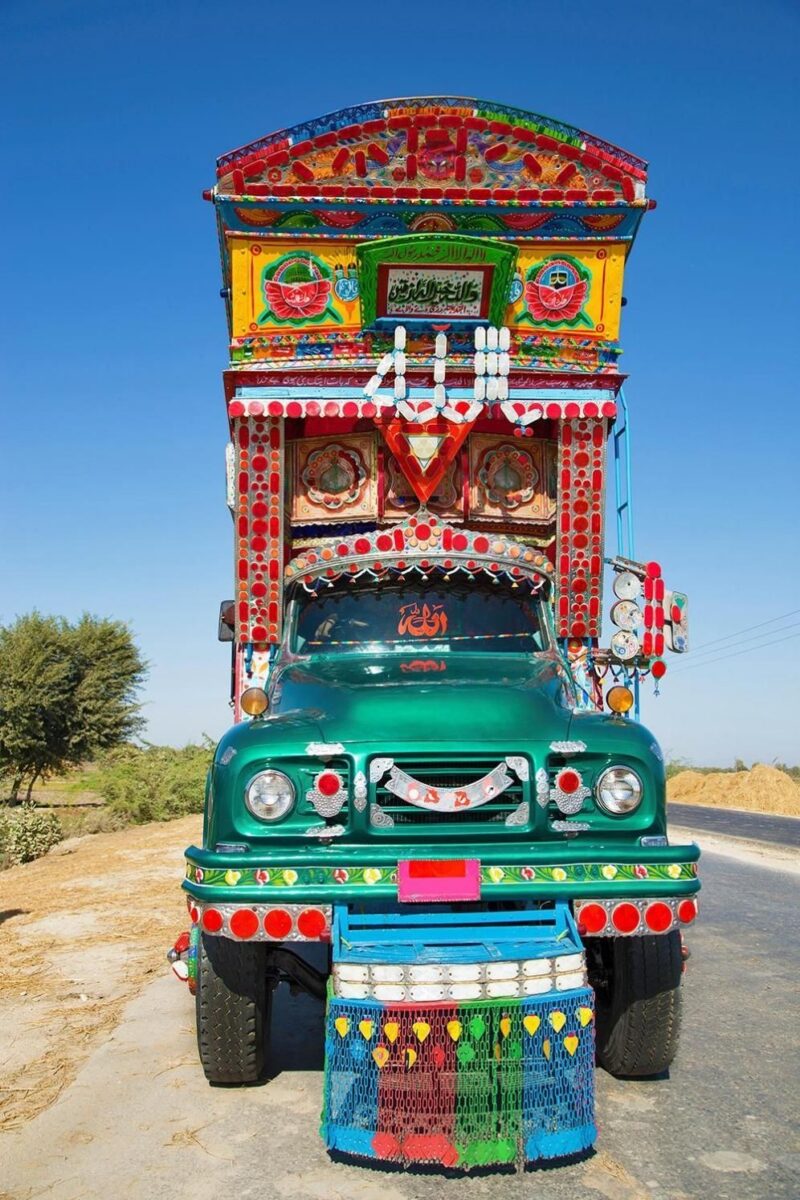
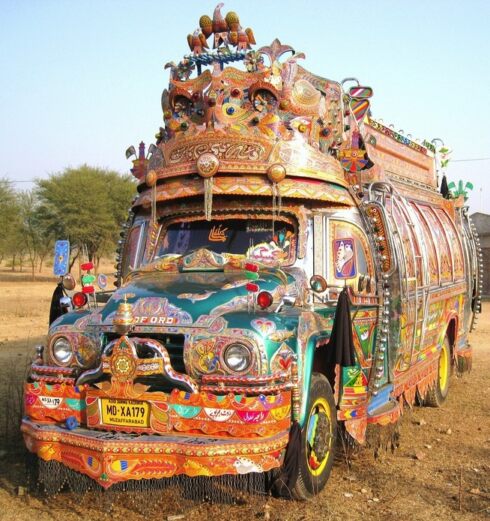
In Karachi you’ll see evidence of full “disco style,” dripping in mirror work and flashing bulbs. Peshawar and Balochistan leaned into elaborate carved wood. Sindh developed a look built on camel-bone inlay and a dominant red palette. Punjab built its own polished, expert-driven style. Uttar Pradesh, meanwhile, became famous for painting actual poetry, full couplets and quartets, across the bumpers of its trucks. The regional distinctions just kind of happened, as most cultural traditions do.

A cheat sheet for reading a truck
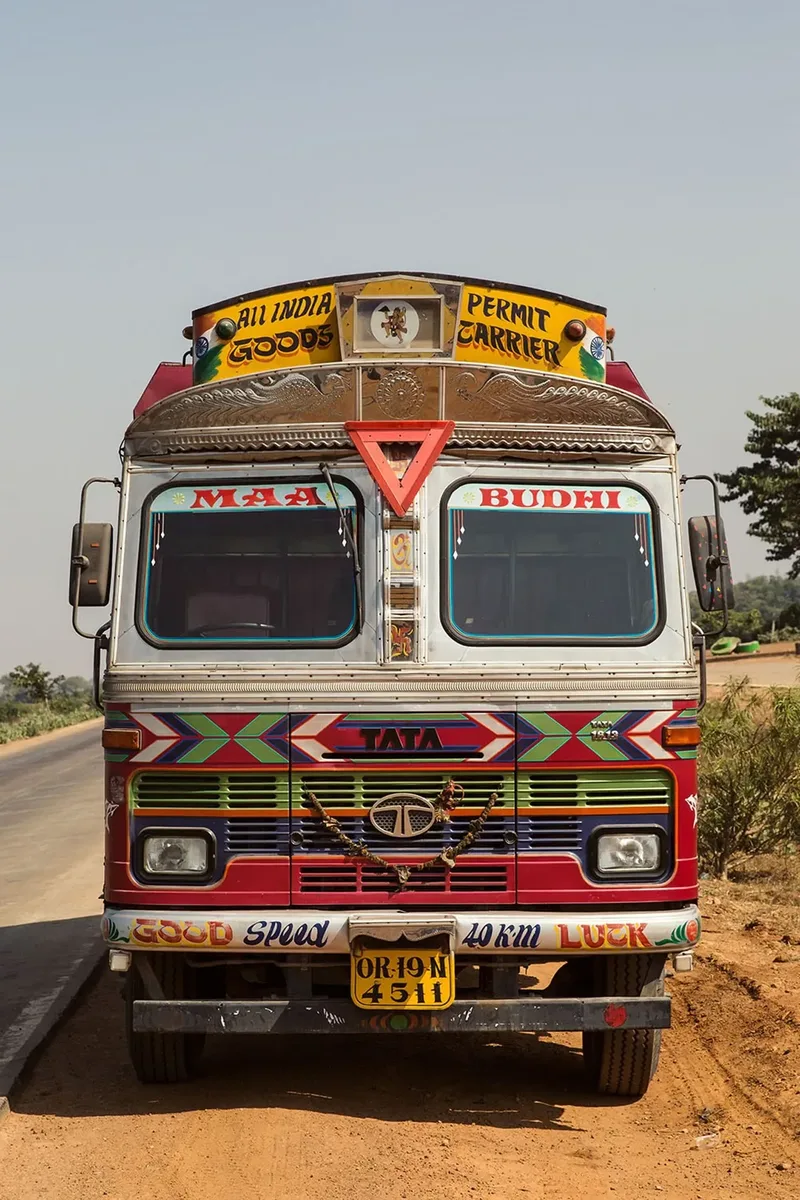
Once you know what to look for, these trucks are basically readable. A white cow nuzzling her calf is one of the most common images out there, and it’s not random. It represents a driver’s longing for the mother he’s left behind for weeks or months on the road, and a bit of comfort that she’s watching over him. A painted eagle means speed, but also carries the idea that no matter how far it flies, its eye stays fixed on home. Then there’s the nazar battu, a grimacing, sharp-toothed face painted on the bumper whose entire job is to intercept the evil eye before it reaches the driver, like the gargoyles you’ll see atop office buildings.
And finally, there’s the phrase you’ll see on the back of practically every one of these trucks: “HORN OK PLEASE.” It sounds like nonsense until you know the backstory. One widely cited explanation dates it to the World War II era, when “OK” was shorthand indicating a truck ran on kerosene, a notably flammable fuel, meaning other drivers needed to keep a respectful distance and use their horn before attempting to pass. The phrase stuck around long after anyone remembered why, and it’s become the unofficial mascot slogan of the entire tradition.
The life of a truck painter
One truck painter, Kamlesh Shinde, works out of a truck yard near Mumbai’s ports. He’s been at it for decades: self-taught, he learned the trade the way most truck artists do, informally from someone already doing it. Weather permitting, he and a partner can turn around eight or nine trucks a week, working outside in a dirt lot. In India, a standard job runs somewhere around 1,000–1,500 rupees, roughly $12–$18 USD. Pakistan’s most elaborate, full-coverage designs, by contrast, can go for something like 100 times that.
When asked what his favourite thing to paint is, Kamlesh didn’t hesitate: whatever pays the most!
A tradition in decline
Of course, in our modern age, hand-painted trucks are becoming rarer. Prefabricated cabs, cheap radium stickers and mass-produced vinyl decals are faster and cheaper than commissioning an artist and waiting three or four days for paint to cure. Veteran painters describe a real decline over the past decade, and more than one has said, without much drama, that they don’t especially want their own kids to inherit the trade, since the economics keep getting tighter. Driving past a mix of older and newer trucks today, you can spot the difference at a glance: older ones are covered edge to edge in hand-painted detail, while newer ones are increasingly a patchwork of paint and pre-made stickers.
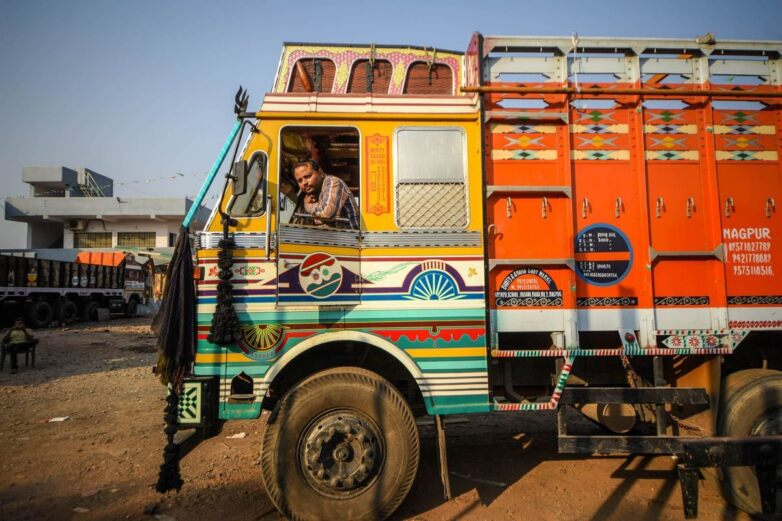
From South Asian highways to the Smithsonian
Truck art has had a surprisingly glamorous second act. The Pakistani artist Haider Ali, trained by his father, first caught international attention in 2002 when he painted a truck for the Smithsonian Folklife Festival in Washington, D.C. A piece of this now lives permanently in the Smithsonian’s collection, and he’s gone on to decorate shipping containers, aircraft and public murals around the world. Dolce & Gabbana built truck-art-inspired displays into a 2015 campaign. The look has turned up on runways, on sneakers and in collections from brands like Satya Paul and even Lego.
One of the more heartening chapters, though, belongs to a designer named Farid Bawa, who grew up around his family’s transport business in India watching truck artists at work. In 2018 he launched a project called All India Permit, which supplies working truck artists with steel canvases so they can keep creating and selling their art even as commissions on actual trucks dry up, with the proceeds going directly back to the artists. The project has gone on to collaborate with brands including Vans and Levi’s, and even sent a mobile art gallery, a truck loaded with truck art, on a 1,000-kilometre road trip from Nagpur to Mumbai.
So the next time a plain white delivery van rolls by, it might be worth a small moment of envy for the drivers halfway around the world who get to haul cement in a truck hand-painted in a riot of colour deep with meaning!
Sources
- Wikipedia, “Truck art in South Asia”
- Hyperallergic, “India’s Vibrant and Idiosyncratic Truck Art” (Radhika Iyengar)
- The Autopian, “I Flew To India And Learned The Secret Behind The Country’s Incredible Hand-Painted Trucks” (Steve Balistreri)
- Homegrown, two pieces on Farid Bawa and All India Permit
- ResplendArts, “Wheels of Expression: The Art and Typography of Indian Trucks”
- Motoring World, “Issue Special: Trucking Masterpieces”
- Indiag blog post on the history and culture of Indian truck art
- Miss Jess Rose blog post on the hand-painted semi trucks of India
- CNN Travel article on India’s truck art

Amanda DeVries RGD
Eye Candy Design
Related Articles




Sponsored