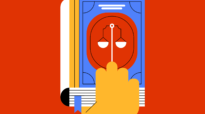
Member Perspectives: Design was cancelled, not replaced
Why the real threat to designers isn't AI, but the illusion that it has already replaced them

It's my turn to talk about AI.
The amount being said and written about AI is astounding and ranges from fear and hate to optimism and opportunity. I have some thoughts that I haven't heard expressed yet.
Obviously, there are huge shifts in creative industries caused by AI and, as a consequence, fears of being replaced by a bot. Many creatives suffer from a lack of work or miserable earnings. Recently, I met five newly graduated designers in Toronto who have been unable to find work for a year. Some of them can't even get an interview. LinkedIn increasingly resembles a digital bread line for mid-level and senior creatives.
The truth nobody is sharing is that AI has done less damage through replacement than through the illusion of replacement. Mostly, AI accomplishes work that never really needed to be done in the first place. If AI were replacing designers, besides the professional struggles, we should see a flourishing world full of great design implementations, cosy urban environments, artistic advertising, goods of rare beauty and meaningful innovations. We should see a design boom, or at least a return to pre-AI levels.
What we really see is a huge creative decline, with an invasion of primitive clichés, amateur execution and a visual culture bordering on absurdity. It is unpopular to say this out loud, but today agencies with legendary names produce design that looks like a college grad show. Luxury brands have started to look like regional startups. Yet they proudly advertise themselves as "AI-powered" while running workshops on AI implementation. The culture of positive thinking keeps publicly admiring all of this and presenting it as an achievement, while more and more good designers quietly admit that the problem is becoming impossible to ignore.
Why quietly? Because saying upsetting things earns you the label of a toxic person. When criticism becomes socially risky, mediocrity becomes harder to challenge.
So what is wrong?
I don't see a threat from AI, but I do see a threat from AI evangelists. These are enthusiasts with bright faces and happy smiles who are eager to spread their clickbait wisdom by saying: "AI will replace all designers soon," "AI can do this work for free in a second," "AI created my logo," "Your profession will disappear" or "This is a new reality you need to accept."
Such messages plant dangerous seeds in people's minds, suggesting that creative work is simple, accessible and cheap. Businesses are being sold the illusion that design can be generated instead of developed. As a result, companies reduce their investment in design, hoping to get the work done for free or for a dollar. But eventually, the work is not done. The result is weaker brands, weaker products and weaker customer experiences.
Design was cancelled and not replaced.
Part of the problem is simple economics. When something becomes abundant, accessible and nearly free, its perceived value declines. Creative output is now easier to produce than at any point in history. Yet abundance does not automatically create meaning.
Based on my observations, we are entering an era where more and more design is being created, but less and less of it leaves a lasting impact. We are moving from an era where a few people created ideas that influenced millions to an era where millions create ideas that influence almost no one. Design is meant to create experiences through emotion. AI-generated design delivers AI-generated emotions.
The challenge is no longer producing more creative content. The challenge is creating work that matters.
AI is not replacing designers. Designers are losing their jobs because the understanding of design's value has been distorted. And that distortion was created by humans for humans, with no AI involved.
I don't have a magic solution. But perhaps the first step is being honest about the problem and investigating it more deeply. We need to distinguish between work that can be generated and work that must be developed. When expertise is treated as optional, judgment is replaced by guesswork.
Feel free to call me opinionated on social media.
The cover image for this article was AI-generated using the following prompt: "Generate a logo that looks excessively AI-generated. Combine as many AI-related clichés as possible into a single logo. Use the exact text: Design was cancelled and not replaced."

Yurko Gutsulyak RGD
Gutsulyak.Studio
Tag
Related Articles


Yurko Gutsulyak RGD


Yurko Gutsulyak RGD